The 1956 Hungarian Uprising Was a Working-Class Revolt
· Jacobin
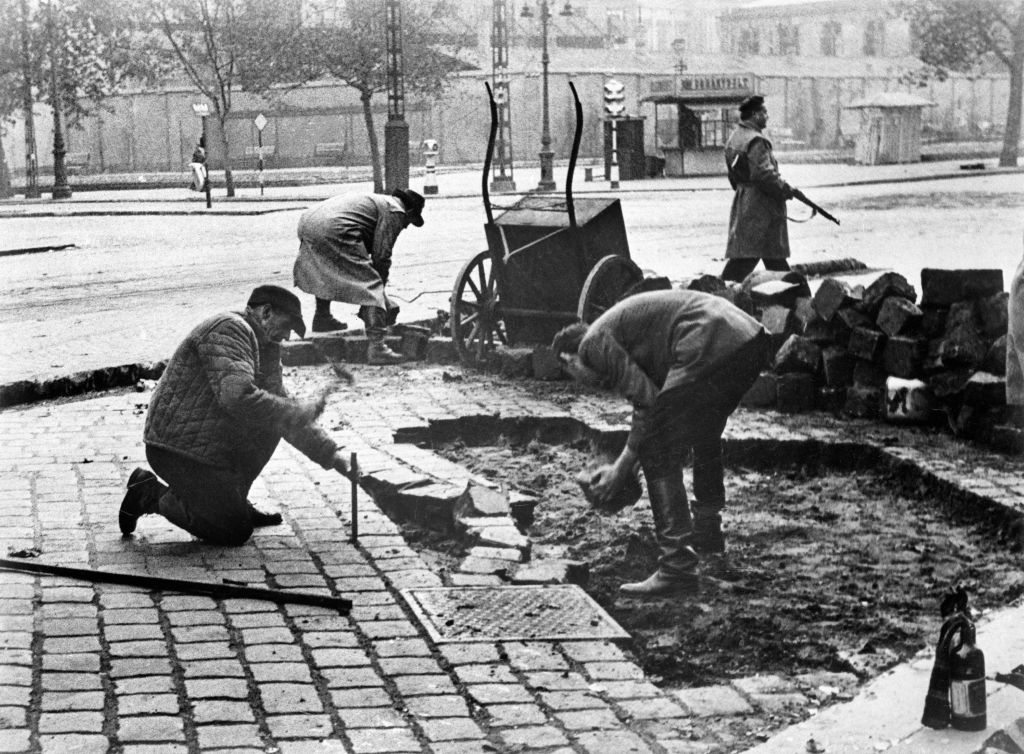
On October 23, 1956, tens of thousands of Hungarians took to the streets of Budapest. What began as a demonstration led largely by students rapidly became a popular uprising against the country’s Stalinist government.Within days, the authority of the Hungarian Communist Party had crumbled, Soviet troops had been forced to withdraw, and workers across the country were establishing their own councils to organize production and exercise political power.The Soviet leadership called it a “counterrevolution,” while Western governments celebrated it as a “revolt against communism.” Both interpretations obscured something fundamental: the Hungarian Revolution was driven by workers and ordinary people who wanted to free themselves from a system that claimed to represent their interests.The uprising was ultimately crushed by Soviet military intervention on November 4. Thousands were killed; hundreds were executed in the repression that followed; and some two hundred thousand Hungarians fled the country. Yet the revolution remains one of the twentieth century’s most important challenges to authoritarian rule in the name of socialism.For the international Left, its significance is difficult to overstate. As the Hungarian Marxist philosopher G. M. Tamás observed, Eastern Europe was precisely where socialism had supposedly been put into practice. What, then, were we to make of workers rising en masse against a self-proclaimed socialist government?The answer begins with the contradictions of the Hungarian state itself — and with the people who dared to challenge it.The Crisis of Stalinist HungaryBy the mid-1950s, Hungary was a country of roughly ten million people still recovering from the devastation of World War II. Following the defeat of Nazi Germany, it had been incorporated into the Soviet sphere of influence. Its economy was reorganized around state ownership, central planning, and rapid industrialization, while political power was concentrated in the hands of a Communist Party modeled on the ruling party in Joseph Stalin’s Soviet Union.Under the leadership of Mátyás Rákosi, the party pursued an especially brutal version of this model. Heavy industry received priority over consumer goods, agriculture was subjected to forced collectivization, and living standards were sacrificed to ambitious production targets. The secret police, known as the State Protection Authority (ÁVH), became the instrument of a pervasive system of surveillance, intimidation, and repression.The government justified these policies on the grounds that they were necessary for building socialism. But workers had little control over their workplaces, peasants faced coercive agricultural policies, and ordinary citizens had virtually no say in political decisions. Although the state owned the factories, that did not mean power was in the hands of the people who worked in those factories.From a critical political-economic perspective, this exposed a deeper contradiction. The state mobilized society for rapid industrial accumulation while subordinating workers to the demands of production. The bureaucracy determined what was produced, how resources were allocated, and how much people were expected to sacrifice. The facade was socialist, but the relationship between rulers and ruled remained profoundly authoritarian.The New CourseThe unexpected death of Stalin in 1953 opened a small space for change. Under pressure from Moscow, Rákosi was replaced as prime minister by Imre Nagy, a reform-minded Communist who recognized that the existing economic model was unsustainable. The new government introduced economic and political reforms, known as the “New Course,” which promised to reduce the emphasis on heavy industry, improve living standards, expand consumer production, and ease political repression.The reforms generated widespread hopes. Forced labor camps were closed, restrictions on private enterprise were relaxed, and peasants received greater freedom to cultivate their land. But the success of the reform program was far from guaranteed. Rákosi retained control of the party apparatus, and powerful Stalinist factions opposed Nagy’s attempts to change course. In 1955, with Soviet support, Nagy’s opponents accused him of “right-wing deviation” and had him removed from office.His dismissal signaled that the state would not tolerate even limited reform when it threatened the authority of the party bureaucracy. The following year, Nikita Khrushchev’s denunciation of Stalin’s crimes at the Soviet Communist Party’s Twentieth Congress further undermined the regime’s legitimacy. If Moscow now acknowledged the terror and injustice of Stalin’s rule, what did that mean for the Hungarian leaders who had faithfully reproduced his methods?Students, intellectuals, writers, and increasingly workers began demanding answers. By October 1956, Hungary was like a tinderbox waiting to explode.A Revolution Takes ShapeThe immediate spark came on October 23. Students gathered in Budapest to demand political reform, the return of Imre Nagy to government, the withdrawal of Soviet troops, and greater national independence. Their demands also encompassed changes to workplace conditions, including opposition to the unpopular piece-rate system that tied workers’ wages to production quotas.The demonstration grew dramatically as people joined the march through the capital. By evening, a vast crowd had assembled outside parliament. Elsewhere, demonstrators pulled down a monumental statue of Stalin, an unmistakable declaration that the old order had lost its authority.The plinth upon which a large statue of Stalin had stood before October 23, 1956. Only the Stalin figure’s boots remain. (Pesti srác2 / CC BY-SA 3.0)The turning point came when demonstrators gathered outside the Hungarian Radio headquarters, hoping to broadcast their demands. ÁVH security forces opened fire, killing and wounding people. The violent response by the government transformed a mass demonstration into an armed uprising. Weapons were seized, police vehicles were set ablaze, and insurgents began confronting the state’s armed forces.The head of a Stalin statue sits in the middle of a Budapest street, on October 23, 1956. (Hofbauer Róbert / CC BY-SA 3.0)The following day, Soviet troops entered Budapest, but their intervention failed to restore order. Some Hungarian soldiers refused to fight the insurgents; others defected or handed over weapons. Nagy returned to the premiership as the authorities struggled to regain control.What had begun as a protest against political repression was becoming something much more radical. The uprising spread beyond the capital to industrial towns, provincial centers, and rural communities. Factories stopped working, local revolutionary committees appeared, and workers began organizing independently of the party and the state.Workers’ CouncilsThis is where the conventional Cold War story becomes inadequate. The revolution cannot be understood simply as a national revolt against Soviet occupation, nor as an uprising orchestrated by anti-communist politicians. Its most consequential development was the emergence of independent working-class organization.Across Hungary, workers established revolutionary councils, elected by their colleagues and answerable to them. These bodies coordinated strikes, organized supplies, represented workers in negotiations, and increasingly asserted authority over factories and local institutions. They were not merely trade unions demanding higher wages. In many cases, they challenged the state’s right to govern workplaces and society without popular consent.Historical estimates suggest that more than two thousand workers’ councils were established during the revolution, involving more than 28,000 members. Their demands varied, but recurring themes included the withdrawal of Soviet troops, political freedoms, the release of prisoners, and genuine worker participation in economic decision-making.For a brief moment, the factory floor became a site of political power. Workers who had supposedly constituted the ruling class discovered that they could organize production and articulate political demands without the supervision of party officials.The revolution was not ideologically uniform. It brought together students, industrial workers, peasants, intellectuals, reform Communists, and supporters of different political traditions. Nor did all its participants share the same vision of Hungary’s future. But the workers’ councils gave the uprising a distinctive social character that neither the Soviet leadership nor its Western adversaries could comfortably accommodate.Beyond BudapestThe working-class dimension of the revolution was particularly evident in Budapest’s industrial districts and in provincial manufacturing centers. Workers in Csepel, Újpest, and Kőbánya joined the resistance, while industrial towns such as Miskolc, Ózd, and Dunapentele (which had been renamed Sztálinváros under the Stalinist regime) became important sites of revolutionary activity.These developments matter because the revolution is often remembered primarily through images of street fighting in Budapest. Yet the uprising spread through the networks of industrial production, workplaces, and communities that underpinned the Hungarian economy.In Dunapentele, workers insisted that their town was socialist precisely because its inhabitants were workers and power belonged in their hands. They declared their intention to defend it against both fascist excesses and Soviet troops. Their statement captured the central contradiction of 1956: they were not necessarily rejecting the ideal of socialism but rejecting a political order that invoked socialism to justify its own domination.Peter Fryer was a correspondent for the Daily Worker, the official newspaper of the Communist Party of Great Britain. He witnessed the uprising and described the devastation inflicted on Budapest by Soviet forces. Working-class districts suffered particularly heavily. Fryer’s reports challenged the official Communist account of a fascist conspiracy and helped expose the reality of the intervention to readers abroad.Workers’ participation was not limited to the construction of councils or the organization of strikes. They also formed a substantial part of the armed resistance. Fighting was particularly intense in industrial neighborhoods, where insurgents used their knowledge of local streets and buildings to resist a much-better-equipped military force.Young workers were especially prominent. Many had grown up under the Communist regime, experienced its workplace discipline and political restrictions, and reached adulthood with little memory of the prewar order. The motivation behind their revolt cannot be reduced to nostalgia for the old Hungary. They were challenging the society in which they had actually lived.The distinction is crucial. The revolution did contain nationalist and anti-communist currents, and some participants sought a restoration of political arrangements from before the war. But these currents do not explain the independent organization of workers across the country, nor do they justify the Soviet claim that military intervention was necessary to defeat a fascist counterrevolution. The revolution’s social diversity should not obscure its central achievement: ordinary people began to exercise political power for themselves.The Soviet CounterattackBy late October, the uprising had forced the government into a series of concessions. Nagy announced a coalition government and, under mounting pressure, moved toward political pluralism. On October 28, the government declared a ceasefire and acknowledged the revolutionary movement. The prospect of Soviet withdrawal appeared increasingly real.But the Soviet leadership faced a dilemma. Allowing Hungary to break decisively from Moscow’s control risked destabilizing the entire Soviet bloc. The danger was not merely that another government might leave the Warsaw Pact. It was that a successful revolution organized from below might inspire workers elsewhere to challenge their own rulers.The crisis also unfolded against a wider international backdrop. Western powers were unwilling to risk a direct military confrontation with the Soviet Union, while the Suez crisis was exposing the limits of Western claims to defend freedom and national sovereignty. Hungary’s fate would ultimately be decided by the balance of power between states, not by the rhetoric of either superpower.On November 1, Nagy announced Hungary’s withdrawal from the Warsaw Pact and appealed for international recognition of the country’s neutrality. Meanwhile, Moscow had already begun preparing a second military intervention. In the early hours of November 4, Soviet forces launched Operation Whirlwind, attacking Budapest and other centers of resistance.This time the assault was overwhelming. Some 58,000 Soviet troops advanced against a revolution that lacked the military resources to withstand a prolonged offensive. Hungarian army units were rapidly disarmed or neutralized, while workers and insurgents continued fighting in several areas.Nagy broadcasted a desperate appeal for help announcing that Soviet forces had attacked the capital and were attempting to overthrow the government. He subsequently sought refuge in the Yugoslav embassy, but was later arrested. In 1958, following a secret trial, he was executed alongside other leaders of the revolution, including Pál Maléter.By November 11, the main centers of armed resistance had been crushed. More than 2,500 people had died during the revolution. The workers’ councils, however, did not immediately disappear. Their continued existence forced the new authorities to confront a problem that military victory alone could not resolve: how to govern a population that had demonstrated such open hostility to the regime.Defeat and the Consolidation of Kádár’s RuleWhile Soviet tanks were reentering Hungary, a new Soviet-friendly government, led by János Kádár, was formed. However, the new government initially faced widespread opposition. Factories remained closed, transport services were disrupted, and workers organized strikes against the Soviet intervention. The Central Workers’ Council of Greater Budapest, established in November, became a focal point for efforts to coordinate resistance and negotiate with the authorities.The government responded with a mixture of concessions and repression. Kádár’s representatives negotiated with workers’ leaders, seeking to persuade them to resume production. But when negotiations failed to break the resistance, the authorities turned decisively toward coercion.On December 9, the headquarters of the Central Workers’ Council was raided and prominent activists were arrested. Martial law was imposed, strikes were criminalized, and imprisonment and execution became instruments of political control. By early 1957, organized resistance was increasingly difficult to sustain. Many young workers fled Hungary, while those who remained faced the prospect of prison, dismissal, or forced submission.The repression was followed by a longer process of political consolidation. Kádár rebuilt the Communist Party (now renamed the Hungarian Socialist Workers’ Party, MSZMP) and sought to win the acquiescence of a population exhausted by conflict.Over time, his government developed a more pragmatic approach to economic management and everyday life. Compared with the brutalities of the Rákosi period, Kádár’s Hungary eventually became associated with relative material security and a degree of private autonomy.But these accommodations rested on the defeat of independent political organization. Workers could enjoy certain improvements in living standards, provided they did not seek to reclaim the political power they had briefly exercised in 1956.The revolution therefore left a complicated legacy. Its defeat did not mean that Hungarian society returned unchanged to the prerevolutionary order. The authorities had learned that permanent mobilization, relentless austerity, and indiscriminate terror could undermine the stability they sought to secure. The memory of 1956 placed limits on the state’s room for maneuver, even as it tried to erase the revolution’s independent working-class character.The Legacy of 1956 TodayThe struggle over the meaning of 1956 did not end with the defeat of the revolution. In contemporary Hungary, its memory remains contested. Following the democratic transition in 1989–90, political commemorations have often emphasized themes of national independence and resistance to Soviet domination that primarily resonate with the emphasis of right-wing political parties on national sovereignty.Under Viktor Orbán’s sixteen-year rule, the state invested heavily in creating an institutionally revisionist memory culture in Hungary, presenting the revolution as a reactionary struggle for “national sovereignty.” However, this picture is utterly detached from the reality of what was happening on the ground in 1956. While reactionary forces sought to co-opt the revolutionary movement at the time, as often happens in mass politics, the struggle did not lose its principled socialist character.The interpretation that stresses the issue of national sovereignty obscures the revolution’s equally important challenge to domestic authoritarianism and the power of political elites. The workers’ councils should remind us that we cannot separate opposition to foreign domination from the question of who exercises power within society. The revolution was not simply a nation asserting its independence; it was also a population challenging a ruling class that claimed to represent it.The lesson extends well beyond Hungary. At a time when authoritarian movements are gaining ground across Europe and elsewhere, 1956 challenges the assumption that political alternatives must be confined to a choice between authoritarian state control and the existing capitalist order. It also offers a warning to the Left: governments cannot claim to represent working people while denying them the freedom to organize independently, challenge political authority, and determine the conditions under which they live and work.The legacy of 1956 is therefore neither simply nationalist nor merely anti-communist. It is a reminder that emancipation cannot be imposed from above, whether in the name of socialism, national security, or economic progress.The Hungarian workers who challenged their rulers demonstrated that democracy means more than choosing between competing elites. It also means the collective capacity of ordinary people to shape their own lives. This crucial class aspect is often excluded from today’s discourse: many commentators attempt to draw parallels with the war in Ukraine, which often reduces this pivotal socialist revolution to merely a struggle for national sovereignty.What 1956 Means for the LeftThe Hungarian Revolution was neither a vindication of liberal capitalism nor the reactionary conspiracy portrayed by Soviet propaganda. It was a heterogeneous popular uprising whose most radical expression lay in the independent organization of workers.That distinction remains politically important. If socialism means only state ownership, central planning, and rule by a party claiming exclusive authority to represent the working class, then the Hungarian workers’ revolt poses an uncomfortable question: What happens when the people supposedly represented by the state rise up against it?We cannot find the answer by dismissing the revolution as an aberration or by ignoring the political diversity of its participants. It requires taking seriously the experience of workers who challenged bureaucratic control, organized their workplaces, and demanded the right to determine their own future.The councils did not offer a complete blueprint for a socialist society. They operated under extraordinary circumstances, and their political projects were neither uniform nor free of contradictions. But they demonstrated that opposition to Stalinism could emerge from a desire for greater democracy and collective control, rather than simply a wish to restore capitalism.For the Left, the lesson is not that the revolution should be claimed uncritically by any particular tradition. It is that socialism cannot be reduced to the power of the state, and workers cannot be treated as passive beneficiaries of policies devised in their name. Emancipation requires their active participation in shaping economic and political life.In 1956, Hungarian workers confronted a regime that claimed to have abolished exploitation while denying them meaningful control over their labor and society. Their defeat exposed the violence required to preserve that contradiction. It also revealed the possibility of another kind of politics — one rooted in collective self-organization, political freedom, and the struggle against domination.The Soviet tanks crushed the revolution. They could not entirely extinguish its challenge to the meaning of socialism. For anyone on the Left still committed to a society governed democratically by those who create its wealth, that challenge remains unfinished.This article originally appeared in Jacobin, a democratic socialist magazine publishing long-form essays and analysis on politics, economics, and culture. Subscribe to the print edition for $20 a year.
Visit casino-promo.biz for more information.