Defeating Zionism to Free Palestine
· The Intercept
Earlier this week, Abdul El-Sayed defeated Mike Rogers in the U.S. Senate race in Michigan after months of Islamophobic abuse, most notably from President Donald Trump, who referred to El-Sayed as “Mohammed.”
Visit umafrika.club for more information.
“Mohammed goes back to the days of the Jihad. He is a RADICAL Extremist, Terrorist Sympathizer,” Trump wrote on Truth Social last month. “Mohammed’s Values are not exactly those of Michiganders, or those of our Great United States of America!” The people of Michigan thought otherwise.
El-Sayed will be the first-ever Muslim U.S. senator. “He rose to victory,” my Intercept colleagues Matt Sledge and Jonah Valdez wrote, “with a campaign animated by his opposition to U.S. support for Israel’s genocide in Gaza, making him a key figure for a left critical of entrenched foreign policy interests and a target for a political establishment intent on preserving the U.S. relationship with the Israeli government.”
In an Election Day equivalent of a Hail Mary, as El-Sayed and Democrats from coast to coast were in the midst of a rout of the GOP, Trump went on Fox News to announce the U.S. would stop providing $4 billion in annual aid to Israel, specifically blaming El-Sayed for making it a hot-button issue. “The left uses the $4 billion payment — that everybody knows about, it’s no secret — as a signal of unfairness,” said Trump.
There is no reason to believe the aid will stop. Trump is an inveterate liar, and structural issues with U.S. assistance make it unlikely. And even if it did end, Israel’s genocide will continue. Almost 75,000 Gazans have been killed since October 2023, according to the Palestinian Ministry of Health in Gaza. A recent U.N. report said, “Israeli authorities and forces continue to commit genocidal acts with the genocidal intent to destroy, in whole or in part, the Palestinians in Gaza.”
Ending the genocide will mean decolonizing Gaza and offering Palestinians a path to justice. That, Noura Erakat and John Reynolds write in their new book, means “confronting the problem of Zionism” and everything fundamental to it: racism, conquest, settler colonialism, and apartheid laws. Today, Erakat and Reynolds offer an essay adapted from “Confronting Zionism,” exploring how the Zionist project can be dismantled and Israeli colonialism can be demolished, leading to Palestinian liberation and a future built on redistribution, reparations, and refugee return.
—Nick Turse, editor and TomDispatch
If you haven’t yet, sign up to receive TomDispatch in your inbox here.
The World at a Crossroads
Three years on from the onset of Israel’s genocide in Gaza, we are at a crucial hinge point. The world today, when it comes to Palestine, stands at the crossroads: meaningful support for liberation and decolonization, or the normalization of colonial expansion and erasure.
Since the 2021 “Manifesto of Dignity and Hope” and the unified call of Palestinians to confront Zionism, the Israeli political sphere has only continued to sustain and entrench its fascist trajectory and its racist laws. After 2023, Israeli settler colonialism and domination escalated into all-out destruction and elimination. Palestinians who had been enduring suffocating apartheid and siege for far too long were now subjected to genocidal assault. Though the context on the ground shifted, the urgent need for a better understanding and challenge to Zionism on political, legal, structural, and ideological grounds remained.
Related
Abdul El-Sayed Won His Senate Seat With a Mandate on Palestine. Can He Deliver?
It was a new generation of Palestinian activists who produced the Manifesto of Dignity and Hope, but their text was shaped by the legacy and spirit of Palestinian revolutionaries and anti-colonial thinkers from earlier periods. Common language echoes through the generations. A quarter-century ago, Palestinian intellectual Edward Said wrote the core of the issue of Palestine “is intellectual truth and the need to combat any sort of apartheid. We should concentrate our resistance on … fully confronting the apartheid provisions inherent in Zionism.” And as diplomat Fayez Sayegh captured it in 1965: Racism is not an acquired or incidental or passing feature of the Israeli state; it is “inherent in the very ideology of Zionism.” Today, we can draw inspiration from these intergenerational reverberations across Palestinian theory and activism, in their consonant commitments to confronting Zionism.
Part of our own task as anti-colonial legal scholars is to expand our analysis of the limitations of narrow liberal legal readings of apartheid and inequality, and to highlight how a radical critique of Israeli apartheid is essential to dismantling Israel’s apartheid regime. This requires scrutiny not only of Zionism and Israeli settler colonialism, but also of the concept of apartheid itself. Apartheid was previously understood in the context of the African anti-apartheid struggle, in a formulation originally coined by the South African Communist Party, as “colonialism of a special type.” By the late 1990s, however, apartheid had been stripped in mainstream understandings of its global character and colonial essence, and effectively reframed as “racial discrimination of a special type.”
One factor in this analytical shift was the domestication of racism in international law, which has obscured its relationship to global capitalism and transformed racism into a problem for individual countries to resolve through juridical reform or diversity, equity, and inclusion programs. Racism is not merely abhorrent because people’s feelings are hurt or one feels unseen, however, but because it is entangled with power and economic structures, and because materially, the continuum of racist violence culminates in genocide, which is squarely understood as a global phenomenon. Martin Luther King Jr. pointed to this in 1967 when he said: “In the final analysis, racism is evil because its ultimate logic is genocide. … If one says that I am not good enough to eat at a lunch counter, or to have a good, decent job, or to go to school with him merely because of my race, he is saying consciously or unconsciously that I do not deserve to exist.”
International law attempts to capture this continuum. Three of the specific acts conducted to maintain apartheid are identical to the acts conducted to commit genocide under their respective legal definitions. In the former, they are done with the intent to dominate; in the latter, with the intent to destroy. These are not mutually exclusive, but rather interact with each other: Colonialism, apartheid, and genocide combine under the Zionist project in Palestine to produce a system of oppression based on conquest, structural racism, dispossession, and elimination.
Related
Israel’s Ruthless Propaganda Campaign to Dehumanize Palestinians
Palestinian opposition to Zionism and the imperatives of decolonization — for political emancipation, material survival, and cultural flourishing — are the central thrust of our work. The colonial origins and early legal mechanics of Zionist settler colonialism and Israel’s apartheid regime reveal how Zionism functioned both as a colonial initiative and a racializing project. This manifested in colonial institutions even before the state was established in 1948, after which they were enshrined in racist legal regimes. A broad structural analysis of the institutional and economic processes of land and capital accumulation that have occurred under settler colonialism in Palestine is necessary to understand the machinery of conquest and dispossession — and the role that racism has played in driving it forward. Drawing on the anti-colonial Palestinian intellectual tradition, we can see that an antiracist analysis has been organic to the Palestinian liberation struggle and is precisely what shaped U.N. initiatives in the 1960s and 1970s that condemned Zionism as a form of racism and racial discrimination alongside apartheid and colonialism.
Israel’s War on Gaza
Despite all the analysis of Israeli state racism and colonial violence since 1948 and all of the mass popular mobilizations and legal advocacy against Israeli apartheid, nothing substantive was done at an international, political, or institutional level to address or redress it. This inaction and the impunity afforded to Israel inevitably culminated in the situation that the world found itself in after October 2023: unsanctioned apartheid accelerating into unadulterated genocide — and given the green light by those who had the power to stop it. There was a decade of increasingly flagged warning signs leading up to this. But Palestinian scholars and international lawyers who had warned of a “prelude to genocide” or “slow-motion” genocide over the years were largely ignored, and in some cases castigated. The consequences have been catastrophic. The United States actively funded, armed, and cheer-led the butchery in Gaza. European Union leaders chose to “stand with Israel” as it announced its starvation policy and war of annihilation.
“Confronting Zionism,” by Noura Erakat and John Reynolds. Available on Bookshop.orgWe would not have ended up in this present moment if the critiques of Zionism as colonialism and racism and the reality of Israel as an apartheid regime had been taken seriously. In 1975, the U.N., led by a Third World majority, declared “international co-operation and peace require the achievement of national liberation and independence, the elimination of colonialism and neocolonialism, foreign occupation, zionism, apartheid and racial discrimination in all its forms, as well as the recognition of the dignity of peoples and their right to self-determination.” Against this, the Western world, led by the United States, has worked to normalize Israeli apartheid.
We see part of our task now as one of continuing to build on the recent “mainstreaming” of condemnations of Israeli apartheid and genocide, but in a way that decisively resists the drift toward narrower, liberal articulations and insists on the importance of radical, anti-colonial, and anti-imperial analysis and praxis. In our work as critical legal scholars, we situate apartheid and the shape it has taken as a category in international law, and we explore the limits and potential of legal tactics, arguments, and institutions to dismantle Israeli apartheid and end the genocide in Gaza. We argue that while legal actions should be pursued in the service of political and social movements, legal logic is insufficient in itself — and can risk narrowing or distorting the horizon of Palestinian liberation. In our view, the proliferating condemnations of Israel by major human rights organizations and mainstream figures in recent years have belatedly reflected the popular consensus and a political reality that Palestinian activism had made undeniable. They also fit, to varying degrees, within a wider pattern of containment.
As one example, take the case of European officials and states finally beginning to acknowledge the heinousness of Israel’s obliteration of Gaza in mid-2025, but doing so primarily in the form of calling for a Palestinian state. They did so only after almost two full years of enabling untold destruction, and refusing to impose any serious sanctions to stem the genocide. Their moves to recognize Palestinian statehood were not about any genuine support for Palestinian self-determination, but rather a way to stabilize the apartheid status quo and try to slow down the Israeli–U.S. drive to continue the erasure of Gaza and full annexation of the West Bank.
Related
Israeli Soldiers Killed at Least 410 People at Food Aid Sites in Gaza This Month
With all of that in mind, it is important to situate the political moment we are in — the increasing focus on Israeli apartheid in recent years and subsequently on the genocide in Gaza — alongside the urgency of thinking about Palestine’s future and our collective responsibilities. In doing so, we have several core aims: to offer a deeper understanding of the nature and extent of Israel’s colonial rule over Palestinian lands and lives; to think through the relationship between the practices of Israeli settler colonialism, apartheid, and genocide on the one hand, and the institutions and ideology of Zionism on the other; to situate Palestinian liberation and its global solidarity alliances as an antiracist struggle and an anti-colonial movement; and to insist on the need for systemic anti-imperial understandings and critiques of Zionism. To properly confront Zionism and avoid the pitfalls of neo-apartheid, we must be attentive to the necessities and practicalities of decolonization.
The decolonization of Palestine today continues a legacy of other liberation struggles — against European colonization globally, against domestic regimes of fascism, against apartheid in southern Africa, and against white supremacy in the United States and elsewhere. These are political orders that Third World, antiracist, partisan, and socialist movements have fought against throughout the past century and more. We must continue that tradition in the service of decolonization by fleshing out the political, legal, historical, and moral reasoning of anti-colonial and anti-Zionist thinking and movements. In our own writing, we feel we are merely providing footnotes to the political education and organizing that has fanned out from Palestine around the world, and that has shaped what millions of activists and people of conscience have viscerally felt: that Zionist colonial rule should and can be dismantled, and that Palestinians must be supported in their struggle to do so.
The stakes of confronting Zionist settler colonialism are high for the entire world: first and foremost for Palestinians’ own liberation, but also because their struggle is at the epicenter of wider global struggles against structures of domination and exploitation. Zionism is a colonial project in Palestine, but also a vehicle of imperialism in the region — agitating for U.S. war and intervention, acting as an antagonist of imperial aggression against Lebanon, Syria, Iran, Yemen and beyond, and actively collaborating with reactionary geopolitical forces globally. Zionism has been further mobilized by ethnonationalists and imperial projects as a proposition on how to organize a society on a basis of racial hierarchy that leaves its excluded groups to perish. Palestinian revolutionary intellectual Ghassan Kanafani always insisted on the importance of understanding the Palestinian struggle in the context of “the alliance between Zionism and imperialism.” And in positioning Kanafani’s analysis in the context of global movements against imperialism today, educator and organizer Layan Sima Fuleihan reiterates the Palestinian cause is “a banner for all of humanity.”
Naji al-Ali, the Palestinian political cartoonist famous for his iconic Hanzala (or “Handala”) character who symbolizes Palestinian resolve and future return, was himself displaced from northern Palestine as a boy during the Nakba and grew up in refugee camps in Lebanon. Kanafani came across Al-Ali and his artwork in Ein al-Hilweh camp and began to publish his drawings in the early 1960s. Al-Ali went on to produce tens of thousands of cartoons over the next 25 years, and through his art was renowned as a voice of Palestinian and Arab political consciousness. In 1984, just a couple of years before he would be assassinated, Al-Ali reflected on what Hanzala and Palestine represented:
I feel that I can recall and sense every bush, every stone, every house and every tree I passed when I was a child in Palestine. The character of Hanzala was a sort of icon that protected my soul from falling whenever I felt sluggish or I was ignoring my duty. That child was like a splash of fresh water on my forehead, bringing me to attention and keeping me from error and loss. He was the arrow of the compass, pointing steadily towards Palestine. Not just Palestine in geographical terms, but Palestine in its humanitarian sense — the symbol of a just cause, whether it is located in Egypt, Vietnam or South Africa.
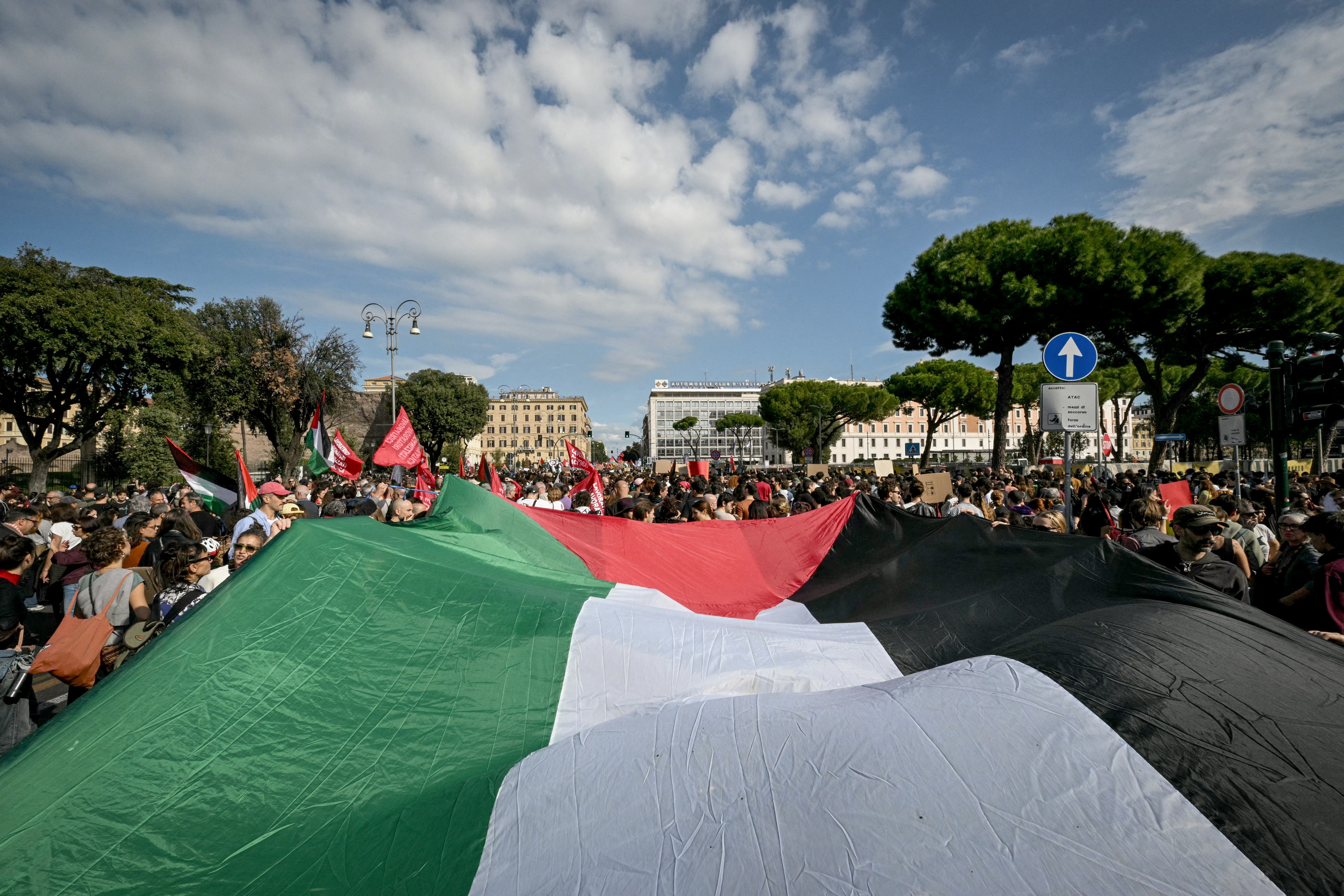
In the decades since then, the idea of Palestine as the compass has resonated in struggles for justice around the world. Most recently, in 2025, the Palestinian Youth Movement and a coalition of solidarity groups brought thousands of activists together for the People’s Conference for Palestine, under the banner “Gaza is the compass.”
Related
Mahmoud Khalil: “We Can’t Afford to Stay Silent”
A wide array of voices, from community activists to trade union organizers to political representatives, emphasized how central Palestine is to all of the social struggles they are engaged in.
Palestinian doctor Mohammad Mustafa articulated the perspective of the many involved in movements for justice across the globe: “Gaza is the measure of our humanity. It is the litmus test that reveals who we are; as individuals, as a nation, as a world. … The compass points in one direction no matter who you are or where you are. In this way it provides a mandate and direction towards freedom for everyone.”
Lawyer and organizer Huwaida Arraf echoed these ideas: “Gaza is our compass because it points us to the truth. … When we’re fighting for Gaza, we’re fighting for a world where no people live in cages or under siege, under the boot of militarism or of fascism.”
Monadel Herzallah from Gaza, who lost five family members in the genocide, insisted the same: “To fight for a free Palestine is to fight for a free Haiti, a free Congo, a free Sudan — a free and just world which will be molded by all of us.”
Palestine is the compass because of what it represents as a banner for all humanity, and because of the horizons it opens up everywhere in imagining and building a new world.
Excerpt adapted from “Confronting Zionism: Decolonizing Palestine and Building the World Anew,” coming from Haymarket Books on November 10, 2026.
The post Defeating Zionism to Free Palestine appeared first on The Intercept.