Another Detroit Socialist Is Heading to Congress
· Jacobin
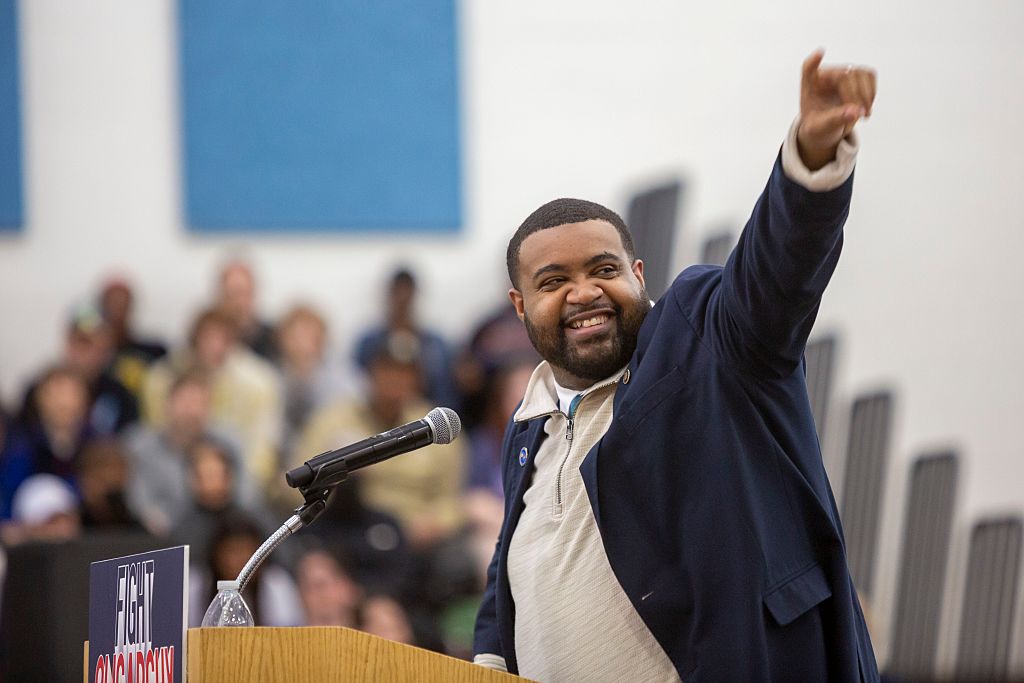
In 2018, the election of two democratic socialists to the House of Representatives marked the beginning of a new political era. The socialist freshmen, both endorsed by the recently reinvigorated Democratic Socialists of America (DSA), were Alexandria Ocasio-Cortez from New York City and Rashida Tlaib, representing Michigan’s Twelfth Congressional District in Detroit.Eight years later, DSA boasts more than 120,000 members and politicians in elected offices across the country. And after a wave of Democratic primary victories earlier this year, democratic socialists are set to significantly grow their foothold in Congress in today’s general election.Among the likely socialist victors is Donavan McKinney, who is expected to win easily in Michigan’s deep-blue Thirteenth District in Detroit and join Tlaib in representing the Motor City in the House. Jacobin spoke to him about why he’s running and how growing up working class in Detroit shaped his politics.Sara WexlerWhy are you running for Congress?Donavan McKinneyI’m running to bring the urgency that this moment demands.Right now, I represent the poorest state house district in Michigan: $14,000 is the median income. If you divide that up by twelve months, that’s a little over $1,200 a month. And the average rents in our neighborhoods, if you’re lucky, start at $1,300.So that’s all your money down the drain, and you’ve got to worry about the increase in the price of gas and groceries, and insurance costs, whether it’s health insurance or auto insurance. We have some of the highest auto insurance rates in the country. Then childcare costs as well and so many day-to-day expenses.I’m running to represent one of the five poorest congressional districts in the country. What I’m going through on the state level is the same thing. [Being in Congress will mean representing] bigger communities, a lot more people. However, it’s the same narrative — the same story: “I just don’t have enough resources to make ends meet.” So for me, this is about meeting the moment, getting people in these positions who are going to put working families first and put our district first.Sara WexlerCan you tell me about your campaign platform? What priorities are you running on?Donavan McKinneyUniversal childcare, Medicare for All, and getting big corporate money out of politics.First, I talk about universal childcare a lot as a state legislator. I coled the movement for Pre-K for all. We have pretty much universal pre-K in Michigan now because of our advocacy and the advocacy of many others. We want to expand that to childcare across the board; we’ll take the fight to Washington, DC, for universal childcare.For my wife and I, that’s the biggest expense in our day-to-day lives, because we have three beautiful children — two boys, four and two, and a baby girl who just turned one. We pay more for childcare for one of our children than we do for our whole mortgage. And you’ve got to think about how impoverished my district is. If we’re living paycheck to paycheck off of childcare alone, I don’t know how everybody else is getting through it.Second, Medicare for All: I’m a big believer because of my mom and what she had to go through. When I was an undergrad at the University of Michigan, I got a call from my mom panicking because she was rushed to the hospital emergency room and they had to do emergency brain surgery. She comes to find out that she had brain tumors growing. And at the time, the only way she could get health care was through her employer; she was working at the time, but her employer didn’t offer it.So she was uninsured. And they did the emergency surgery, but guess what? She got that big six-figure bill for that procedure, and she didn’t have any way to pay it. They put her on a payment plan, but I had to go work three jobs at the time while I was a full-time student to make sure that she got the care she needed. By the grace of God, the Affordable Care Act (ACA) kicked in not too long after that, and she was able to afford health care. But I’m a big believer in Medicare for All, because she had preexisting conditions. Whether you have a preexisting condition or not, you deserve health care.That’s why I’m a big proponent of Medicare for All. There [are so many problems] when it comes to ACA premiums, as well as my seniors on fixed incomes, rubbing pennies together to try to figure out if they should have food on their table for the day or pay more out of pocket for their doctor’s visits and skyrocketing costs when it comes to lifesaving prescription drugs.The third thing I talked about is getting money out of politics. I’ve led that initiative here at the state level. I’ve introduced that legislation two times since I’ve been in office, in back-to-back terms. Each term, we got more and more people. I think the first term we had fewer than ten people sign on. This time around, when we introduced it last year in the state legislature, I think we had thirty or forty people sign on.Now, if you look at every Democrat who’s running for state legislative office here in Michigan, they signed on to the Michiganders for Money Out of Politics initiative. We couldn’t get a hearing in the state house. So organizations and people on the ground decided to take back our power over legislation and create a ballot initiative. They collected six hundred thousand signatures across the state, and that initiative will be on the November 3 ballot. I’m excited about it, because it targets monopoly utility companies, our public utilities, as well as our insurance companies — health insurance companies and auto insurance — which give a lot of money to state legislators to really bend the needle toward them instead of working people.I’m looking to do the same thing federally, to sign onto the legislation of Congresswoman Summer Lee and Senator Bernie Sanders, which gets rid of all that dark super PAC money, as well as to overturn Citizens United. Those are my big three pillars.Sara WexlerYou grew up working class in Detroit. Can you tell me a bit about your background and how that shaped your politics?Donavan McKinneyI was born and grew up in Detroit, raised with my mom, my grandmother, and my younger brother. We moved thirteen times across the city; I spent the vast majority of my life in northeast Detroit, which I now represent in the state legislature. And if the general election goes well, I’ll be representing it in the halls of Congress.Like I said, we moved thirteen times. We stayed in cars, shelters, sometimes out in the street. We didn’t know where our next meal was going to come from, but there was no shortage of love and prayers that got us through those tough times.I remember what my grandmother told me growing up. She told me two things that I still live by today. Number one is count your blessings, because you woke up this morning when a lot of people didn’t. You have a roof over your head, clothes on your back, food on your table, and — we live in Detroit, the Motor City — a car to drive. Because our transit system isn’t that good yet, but we’re working on it; that’s something we’re going to take to DC to work on. But you’re able-bodied, you’ve got your mental health, you’ve got your faculties, things we take for granted day in and day out.Number two, she always used to say, “In life, there will always be people better off than you. There will always be people worse off than you, but never fight the urge to give.” And I put that quote on my first piece of literature when I first ran for state representative ten years ago, back in 2016 when I was just a bushy-tailed kid coming out of college, just trying to figure out life.I still live by those two principles today — they’re my North Star. That’s why I’m so passionate about working people and about the service, because that’s what’s forgotten in politics. [I like to say], politics is about the service of the people and bringing humanity and love and leading with your heart back into the politics, which [currently] is so divisive. There’s a lot of hatred, a lot of negativity, and we try to lead with love.Sara WexlerIt seems like when you were growing up, people’s needs weren’t being met, and the affordability crisis was worsening, regardless of whether Democrats or Republicans were in power. What do you make of this?Donavan McKinneyA lot of people I’ve talked to view the Democrats and the Republicans very similarly when it comes to economics. I do believe that the Democratic Party is the party of the people. I have seen the Democrats do a lot more than the Republicans in terms of [helping the] working class. But I’m a big believer in the Scripture. Scripture talks about how you can’t serve two masters.What is happening, especially now, is that the Dems are serving the corporate oligarchs, same as the Republicans. You’re either going to have to do what’s best and serve the interests of working people, or you’re going to serve the interests of just a few and increase the wealth of those who are taking advantage of regular working people.For me, we follow what we preach. That’s what people want to see. They want to see receipts. So look at our campaign: we ran a campaign that was people powered. We didn’t take a cent of corporate PAC money or AIPAC [American Israel Public Affairs Committee] money. A lot of our money came from individual people across our district, across our state, across our country, who believe in a different style of politics. Leading up to the primary, our average donation on ActBlue was around $30 or $32, something like that — tens of thousands of people just donating to a vision.I’m forever grateful for it, because we were outspent. My opponent [in the primary], the current congressman, had his own wealth. He made his money off of pharmaceuticals, and so he had his own money to put in. But he also took money from ICE [Immigration and Customs Enforcement] contractors and AIPAC as well as other corporate PACs, crypto, all of that — DTE, our monopoly utility — and just lying on our name, putting a lot of ads out. I’m very grateful, by the grace of God, that people were really waking up and realizing, “You know what? Donovan is better for the job.” We’re bringing a message that resonates with people and brings folks together.Sara WexlerBefore running for office, you worked for Service Employees International Union (SEIU) Healthcare Michigan, which is the state’s largest health care union. How has your experience with labor organizing informed your politics?Donavan McKinneyI tell this story a lot about my grandfather. My grandfather passed away late last year during the campaign cycle. I’m trying to not be emotional, because the man taught me a lot. When I was a kid, he used to bring me to the union meetings a lot. He worked at Ford Motor Company in the Detroit metro region and was part of the United Auto Workers (UAW) for forty-two years.One of the most interesting things about my grandfather is that during those forty-two years, he never missed a day of work. I asked him at his retirement party some years ago, “Granddad, how did you do it?” He told me one thing that stood out, which was that he took pride in what he was doing. He knew that, with his bare hands, he was helping change a life or a family’s life. But more important, he knew that not only the union had his back, but that Ford Motor Company had his back.But fast-forward to the year 2026, that work that he had and that salary that he made — that dollar isn’t stretching as far. And these corporations have gotten greedier. Take, for instance, what happened at the Poletown plant in my district, which is on the border of Detroit and Hamtramck. It’s a General Motors factory plant. It’s nicknamed “Factory Zero.” It was the first factory in America, and the first factory in America to be net zero. It was really green, really environmentally friendly and forward-thinking around that.Earlier this year, they cut over a thousand jobs, all union jobs. They cut everybody’s jobs, and then, just a few months later, replaced them with robots. I talk about it in the union halls a lot; I talk about how much it’s bullsh–t and how, at the end of the day, nobody has our back but working people ourselves. We need to start electing folks with the right type of mindset and, more importantly, with the lived experience that [leads them to prioritize working people] over these greedy corporations.Sara WexlerThat leads nicely into my next question. You’re running as a democratic socialist. What does that mean to you?Donavan McKinneyI define politics as the redistribution of resources. That’s it; it’s black and white.If you’re in these positions of power and influence, if you’re not trying to figure out ways to bring home as many resources as possible back to your communities and the people you represent, then I need you to get up out of here. That’s what led me to run for Congress in the first place, because I felt like our current congressman wasn’t meeting the moment. We’re going to be able to pick up the phone and do constituent service work, because I understand what it’s like being on the phone trying to get somebody to answer to help when you’re in dire need. My current congressman is known for not picking up the phone, not doing the real constituent work of the job.Half the battle is showing up. The other half is trying to figure out resources to improve the quality of life of the people you represent. So in terms of democratic socialism, I’m a big believer in Dr Martin Luther King’s teachings. And Tupac [Shakur] said it best: “They got money for wars but can’t feed the poor.” You’re telling me we’re spending money for a war that nobody wants — a billion dollars a day in Iran. And you’re also telling me that, with H.R. 1 [the One Big Beautiful Bill Act], the Republican trifecta cut health care and food assistance for the most vulnerable populations across our country.And I thought Republicans didn’t believe in red tape: I thought they believed in slim government and lean government and achieving efficiency in government. But they want to hurt people in order to give a tax break to the wealthiest top 1-percent earners of our country. They’re telling people, “We want you to get recertified every six months for your health care. But we DOGEd government, and we know that you’re not going to get recertified in time because we don’t have the caseworkers to certify you in the right amount of time. Because of the savings we’re going to have on the back end from folks not being able to recertify, we’re going to give a tax break to the ultrawealthy.”That’s not the America I want to live in; that’s not the America people in my community want to live in, or anyone who I know wants to live in. It’s up to us Democrats to level the playing field and right the ship, so to speak. I’m going to push hard as hell and advocate for the poor folks in my communities. A lot of my community is struggling and they’re looking for somebody that’s going to fight for them, and that’s my job.Sara WexlerAs you mentioned, you were able to oust the incumbent Democrat in your primary. I’m wondering what role different organizations, DSA for instance, have played in your campaign.Donavan McKinneyI was quoted earlier in the campaign, and I said, “We’re building the biggest and baddest coalition in the country,” which is true. I’ve even had members of Congress call me because they’re like, “Yo, how did you do this?” We have some of the most established folks and even the most conservative Democrats endorsing our campaign, as well as all-the-way-to-the-left DSA types endorsing our campaign. I don’t know if it was just because of me or also because of how bad the incumbent was, but it’s because we’re speaking values.We’re leading with our heart, and we’re following what we’re preaching. We brought together faith leaders, elected officials from the federal, state, county, and local levels, community block club leaders, and unions. I was told I was the only nonincumbent the AFL-CIO endorsed on the federal level when it came to the Democratic primary.So we had the unions; we had groups like Justice Democrats and DSA and so many other great folks coming together and realizing that we deserve better. That was our campaign message: We deserve better. I’m so grateful because I couldn’t have done it without this coalition. I couldn’t have done it without people coming together and realizing that their voices matter and that they have the power to make a difference in our politics and change the trajectory of our country.We’re going to continue that movement as we get sworn in in January. It’s the inside-outside strategy that Dr King talked about. You need people on the outside agitating, advocating, but you also need people on the inside who are willing to listen, willing to really put those words to paper and move legislation very swiftly in this moment, with the urgency that it demands.This article originally appeared in Jacobin, a democratic socialist magazine publishing long-form essays and analysis on politics, economics, and culture. Subscribe to the print edition for $20 a year.
Visit palladian.co.za for more information.